jueves, 5 de septiembre de 2013

Michoacán, autodefensas, delincuencia y vacío de poder


Indígenas purépechas enmascarados de un grupo de autodefensa de la población Los Reyes, Michoacán. (AP Foto/Gabriela … 

Un miembro de la llamada "autodefensa" durante una ronda de seguridad en el pueblo de Aguililla. (AFP | ronaldo …Las autodefensas se han convertido en el peor enemigo de los narcos. (Cuartoscuro)Hace seis años inició la acción de la Federación en contra de la delincuencia organizada en Michoacán, desde entonces ha avanzado de manera consistente el poder de los grupos que en esta entidad se dedican a traficar con las drogas que producen, extorsionar a comerciantes, ganaderos, agricultores y particulares; también a secuestrar y desde luego que siendo insuficiente la fuerza del Estado, asesinan, levantan y torturan.

En Michoacán es evidente el vacío de poder. Un gobernador enfermo y con licencia, un gobernador interino, la federación a la expectativa y la delincuencia organizada en proceso de consolidación de su dominio en diversos municipios. Se disputan el territorio La Familia Michoacana y Los Caballeros Templarios que ante el deterioro de la economía nacional y estatal se han convertido en la alternativa para la subsistencia de muchos grupos que son reclutados por su voluntad, por presión o por el miedo que les da mantenerse al margen.

Algunos municipios se sienten abandonados por el Gobierno en sus tres niveles y por ello, siguiendo el modelo del estado de Guerrero, comenzaron a organizarse y surgieron los grupos de autodefensa en un intento por neutralizar la violencia de la delincuencia organizada. El resultado es de enfrentamientos armados entre las comunidades organizadas para su autodefensa y seguridad y la delincuencia organizada que no está dispuesta a ceder el dominio sobre las comunidades que hoy se rebelan en un intento por salvarse de la violencia.

En diversos municipios de Michoacán la economía se ha detenido debido a que los pueblos organizados para su autodefensa han sido bloqueados por la delincuencia organizada que impide a los agricultores sacar sus productos al mercado. Algunas de estas comunidades no han logrado vender su limón, ni su aguacate, además la delincuencia impide que sea abastecida la gasolina de manera que el transporte ha sido paralizado.

Tampoco se permite la entrada de mercancías a estas comunidades. No se da acceso a los comerciantes que abastecen a los pueblos de productos básicos. Diversas empresas cancelaron la distribución de productos por las amenazas que han sufrido sus trabajadores de parte de la delincuencia organizada.

Javier González Franco, director general de Bimbo, comentó que hay desabastecimiento de alimentos en algunos poblados de Michoacán por las restricciones que imponen los grupos del crimen organizado. “No nos gusta arriesgar a nuestra gente y ellos lo saben”.

Todo esto pasa en algunas regiones de la entidad sin que las autoridades municipales, estatales y federales hicieran algo por impedir las acciones de la delincuencia organizada y promover el retorno a la normalidad.

Como parte de una nueva estrategia de seguridad para Michoacán, Alberto Reyes Vaca, general de División Diplomado del Estado Mayor Presidencial, asumió la coordinación general de las fuerzas policiales y castrenses que pretenden rescatar a la entidad de la violencia e inseguridad. Su nombramiento implica el inicio del mando único en los cuerpos de seguridad y será una especie de ensayo que podría aplicarse en otras entidades con problemáticas de seguridad similares.

Con el mando único se llevarán a cabo acciones de seguridad para enfrentar la situación de violencia que enfrenta Michoacán, sobre todo en las regiones de Tierra Caliente y la Meseta Purépecha, donde ha proliferado el surgimiento de grupos que se autonombran policías comunitarias, recientemente se ha reportado la aparición de estos grupos en Ario de Rosales, Los Reyes y Coalcomán, en esta zona del estado se manifiestan las protestas de los estudiantes normalistas.

Los grupos de autodefensa en Michoacán se han convertido en el mayor enemigo de Los Caballeros Templarios que han tratado de presentar a los grupos de autodefensa como instrumentos de sus rivales del cártel de Jalisco-Nueva Generación. El líder de Los Caballeros Templarios, Servando Gómez Martínez “La Tuta”, divulgó un mensaje por video en el que pidió al gobierno que pusiera límites a la operación de las “policías comunitarias”.

El presidente de la Comisión de Gobernación y Puntos Constitucionales del Senado de la República, Jorge Luis Preciado, comentó que “ante la ingobernabilidad en Michoacán, por lo difícil que es vivir para los michoacanos, no hay otra salida sino la militarización, la desaparición de poderes en la entidad, prevista en la Constitución general de la República y que sean las fuerzas armadas las que restituyan la paz social”.

Comentó el senador Preciado que “muchos michoacanos no pueden salir de sus poblaciones, ni tampoco entrar, no les llega alimentos, medicinas, ni los más elementales servicios básicos y se llega al extremo que mucha gente  no puede acceder a médicos o tratamiento de sus enfermedades porque los especialistas han huido o son repelidos”.

Lo que vive hoy Michoacán es una situación de vacío de poder que pone en evidencia que el Estado ha fallado en el cumplimiento básico de garantizar la seguridad de la vida y los bienes de los ciudadanos, pero debemos ser congruentes en el juicio, la entidad atraviesa por una situación de abandono que empezó hace más de 25 años, cuando Cuauhtémoc Cárdenas fue gobernador, da la impresión de que la entidad fue castigada por los políticos del centro que fue dejada al mando de nadie como para que la impunidad creciera para dar paso al neocaudillismo que caracteriza al liderazgo de la delincuencia organizada retadora del poder de la Federación y demás. El restablecimiento de la paz social no será fácil y el deseo genuino es que no sea a costa de sangre, menos si es de gente inocente.

Freedom in the Cloud

Assange, Manning and Snowden are the new heroes of the era of digitalized control.

BY Slavoj Žižek

Radomes at an operating facility of the BND, the main German foreign intelligence gathering agency, near Bad Aibling, Germany. The German government recently confirmed that the BND shares large amounts of data with the NSA, and according to NSA whistle-blower Edward Snowden, NSA operatives work at the Bad Aibling facility. (Photo by Johannes Simon/Getty Images)

We need more Mannings and Snowdens—in China, in Russia, everywhere. There are states much more oppressive than the United States—just imagine what would have happened to someone like Manning in a Russian or Chinese court (in all probability there would be no public trial!) However, one should not exaggerate the softness of the United States.

We all remember President Obama's smiling face, full of hope and trust, when he repeatedly delivered the motto of his first campaign, “Yes, we can!”—we can get rid of the cynicism of the Bush era and bring justice and welfare to the American people.
Now that the United States continues with covert operations and expands its intelligence network, spying even on their allies, we can imagine protesters shouting at Obama: “How can you use drones for killing? How can you spy even our allies?” Obama looks back at them and murmurs with a mockingly evil smile: “Yes we can…”

However, such simple personalization misses the point: The threat to our freedom disclosed by whistle-blowers has much deeper systemic roots. Edward Snowden should be defended not only because his acts annoyed and embarrassed the U.S. secret services. Their lesson is global; it reaches far beyond the standard U.S. bashing. What he revealed is something that not only the United States but also all the other great (and not so great) powers—from China to Russia, from Germany to Israel—are doing, to the extent they are technologically able to do it. His acts thus provide a factual foundation to our premonitions of how much we are all monitored and controlled. We didn’t really learn from Snowden (or from Manning) anything we didn’t already presume to be true—but it is one thing to know it in general, and another to get concrete data. It is a little bit like knowing that one’s sexual partner is playing around—one can accept the abstract knowledge of it, but pain arises when one learns the steamy details, when one gets pictures of what they were doing.

Back in 1843, the young Karl Marx claimed that the German ancien regime “only imagines that it believes in itself and demands that the world should imagine the same thing.” In such a situation, to put shame on those in power becomes a weapon—or, as Marx goes on: “The actual pressure must be made more pressing by adding to it consciousness of pressure, the shame must be made more shameful by publicizing it.” And this, exactly, is our situation today: we are facing the shameless cynicism of the representatives of the existing global order who only imagine that they believe in their ideas of democracy, human rights, etc. What happens in Wikileaks disclosures is that the shame, theirs and ours for tolerating such power over us, is made more shameful by publicizing it.

What we should be ashamed of is the worldwide process of the gradual narrowing of the space for what Immanuel Kant called the “public use of reason.” In his classic text What is Enlightenment?, Kant opposes “public” and “private” use of reason: “private” is for Kant the communal-institutional order in which we dwell (our state, our nation…), while “public” is the trans-national universality of the exercise of one’s Reason:
The public use of one’s reason must always be free, and it alone can bring about enlightenment among men. The private use of one’s reason, on the other hand, may often be very narrowly restricted without particularly hindering the progress of enlightenment. By public use of one’s reason I understand the use which a person makes of it as a scholar before the reading public. Private use I call that which one may make of it in a particular civil post or office which is entrusted to him.
We see where Kant parts with our liberal common sense: The domain of State is “private,” constrained by particular interests, while individuals reflecting on general issues use reason in a “public” way. This Kantian distinction is especially pertinent with the Internet and other new media torn between their free “public use” and their growing “private” control. In our era of cloud computing, we no longer need strong individual computers: Software and information are available on demand, and users can access web-based tools or applications through browsers as if they were programs installed on their own computer.

Once we chose to follow the path of state secrets, we sooner or later reach the fateful point at which the very legal regulations prescribing what is secret become secret. Kant formulated the basic axiom of the public law: “All actions relating to the right of other men are unjust if their maxim is not consistent with publicity.” A secret law, a law unknown to its subjects, legitimizes the arbitrary despotism of those who exercise it, as indicated in the title of a recent report on China: “Even what’s secret is a secret in China.” Troublesome intellectuals who reported on China's political oppression, ecological catastrophes, rural poverty, etc., got years of prison for betraying state secrets, and the catch is that many of the laws and regulations that made up the state-secret regime are themselves classified, making it difficult for individuals to know how and when they’re in violation.
What makes the all-encompassing control of our lives so dangerous is not that we lose our privacy and all our intimate secrets are exposed to the view of the Big Brother. There is no state agency that is able to exert such control—not because they don’t know enough, but because they know too much. The sheer size of data is too large, and in spite of all intricate programs for detecting suspicious messages, computers which register billions of data are too stupid to interpret and evaluate them properly, yielding ridiculous and unnecessary mistakes whereby innocent bystanders are listed as potential terrorists—and this makes state control of our communications even more dangerous. Without knowing why, without doing anything illegal, we can all of a sudden find ourselves on a list of potential terrorists.

Recall the legendary answer of a Hearst newspaper editor to Hearst’s inquiry as to why he doesn't want to take a long-deserved holiday: “I am afraid that if I go, there will be chaos, everything will fall apart—but I am even more afraid to discover that, if I go, things will just go on as normal without me, a proof that I am not really needed!” Something similar can be said about the state control of our communications: We should fear that we have no secrets, that secret state agencies know everything, but we should fear even more that they fail in this endeavor.

This is why whistle-blowers play a crucial role in keeping the “public reason” alive. Assange, Manning, Snowden… these are our new heroes, exemplary cases of the new ethics that befits our era of digitalized control. They are no longer just whistle-blowers who denounce illegal practices of private companies (banks, tobacco and oil firms) to the public authorities; they denounce these public authorities themselves when they engage in “private use of reason.”

We need more Mannings and Snowdens—in China, in Russia, everywhere. There are states much more oppressive than the United States—just imagine what would have happened to someone like Manning in a Russian or Chinese court (in all probability there would be no public trial!) However, one should not exaggerate the softness of the United States. True, the United States doesn’t treat prisoners as brutally as China or Russia—because of their technological priority, they simply do not need the openly brutal approach (which they are more than ready to apply when it is needed)—the invisible digital control can do well enough. In this sense, the United States is even more dangerous than China insofar as their measures of control are not perceived as such, while Chinese brutality is openly displayed.

It is therefore not enough to play one state against the other (as Snowden did, when he used Russia against the United States). We need a new International—an international network to organize the protection of whistle-blowers and the dissemination of their message. Whistle-blowers are our heroes because they prove that if those in power can do their job of controlling us, we can also fight back and throw them into a panic.
Slavoj Žižek, a Slovenian philosopher and psychoanalyst, is a senior researcher at the Institute for Advanced Study in the Humanities, in Essen, Germany. He has also been a visiting professor at more than 10 universities around the world. Žižek is the author of many other books, including Living in the End Times, First As Tragedy, Then As Farce, The Fragile Absolute and Did Somebody Say Totalitarianism? He lives in London.

Exclusive: NSA pays £100m in secret funding for GCHQ

• Secret payments revealed in leaks by Edward Snowden
• GCHQ expected to 'pull its weight' for Americans
• Weaker regulation of British spies 'a selling point' for NSA

and
The Guardian,

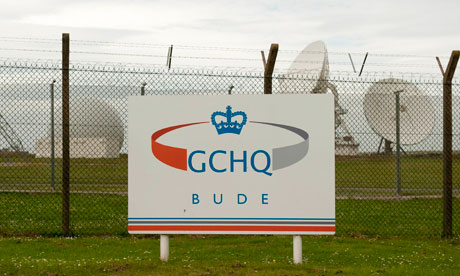
GCHQ's site in Bude, Cornwall
The NSA paid £15.5m towards redevelopments at GCHQ’s site in Bude, north Cornwall, which intercepts communications from the transatlantic cables that carry internet traffic. Photograph: Kieran Doherty/Reuters.
The US government has paid at least £100m to the UK spy agency GCHQ over the last three years to secure access to and influence over Britain's intelligence gathering programmes.
The top secret payments are set out in documents which make clear that the Americans expect a return on the investment, and that GCHQ has to work hard to meet their demands. "GCHQ must pull its weight and be seen to pull its weight," a GCHQ strategy briefing said.
The funding underlines the closeness of the relationship between GCHQ and its US equivalent, the National Security Agency. But it will raise fears about the hold Washington has over the UK's biggest and most important intelligence agency, and whether Britain's dependency on the NSA has become too great.
In one revealing document from 2010, GCHQ acknowledged that the US had "raised a number of issues with regards to meeting NSA's minimum expectations". It said GCHQ "still remains short of the full NSA ask".
Ministers have denied that GCHQ does the NSA's "dirty work", but in the documents GCHQ describes Britain's surveillance laws and regulatory regime as a "selling point" for the Americans.
The papers are the latest to emerge from the cache leaked by the American whistleblower Edward Snowden, the former NSA contractor who has railed at the reach of the US and UK intelligence agencies.
Snowden warned about the relationship between the NSA and GCHQ, saying the organisations have been jointly responsible for developing techniques that allow the mass harvesting and analysis of internet traffic. "It's not just a US problem," he said. "They are worse than the US."
As well as the payments, the documents seen by the Guardian reveal:
GCHQ is pouring money into efforts to gather personal information from mobile phones and apps, and has said it wants to be able to "exploit any phone, anywhere, any time".
• Some GCHQ staff working on one sensitive programme expressed concern about "the morality and ethics of their operational work, particularly given the level of deception involved".
• The amount of personal data available to GCHQ from internet and mobile traffic has increased by 7,000% in the past five years – but 60% of all Britain's refined intelligence still appears to come from the NSA.
 • GCHQ blames China and Russia for the vast majority of cyber-attacks against the UK and is now working with the NSA to provide the British and US militaries with a cyberwarfare capability.
The details of the NSA payments, and the influence the US has over Britain, are set out in GCHQ's annual "investment portfolios". The papers show that the NSA gave GCHQ £22.9m in 2009. The following year the NSA's contribution increased to £39.9m, which included £4m to support GCHQ's work for Nato forces in Afghanistan, and £17.2m for the agency's Mastering the Internet project, which gathers and stores vast amounts of "raw" information ready for analysis.
The NSA also paid £15.5m towards redevelopments at GCHQ's sister site in Bude, north Cornwall, which intercepts communications from the transatlantic cables that carry internet traffic. "Securing external NSA funding for Bude has protected (GCHQ's core) budget," the paper said.
In 2011/12 the NSA paid another £34.7m to GCHQ.
The papers show the NSA pays half the costs of one of the UK's main eavesdropping capabilities in Cyprus. In turn, GCHQ has to take the American view into account when deciding what to prioritise.
A document setting out GCHQ's spending plans for 2010/11 stated: "The portfolio will spend money supplied by the NSA and UK government departments against agreed requirements."
Other documents say the agency must ensure there has been "an appropriate level of contribution … from the NSA perspective".
The leaked papers reveal that the UK's biggest fear is that "US perceptions of the … partnership diminish, leading to loss of access, and/or reduction in investment … to the UK".
When GCHQ does supply the US with valuable intelligence, the agency boasts about it. In one review, GCHQ boasted that it had supplied "unique contributions" to the NSA during its investigation of the American citizen responsible for an attempted car bomb attack in Times Square, New York City, in 2010.
No other detail is provided – but it raises the possibility that GCHQ might have been spying on an American living in the US. The NSA is prohibited from doing this by US law.
Asked about the payments, a Cabinet Office spokesman said: "In a 60-year alliance it is entirely unsurprising that there are joint projects in which resources and expertise are pooled, but the benefits flow in both directions."
A senior security source in Whitehall added: "The fact is there is a close intelligence relationship between the UK and US and a number of other countries including Australia and Canada. There's no automaticity, not everything is shared. A sentient human being takes decisions."
Although the sums represent only a small percentage of the agencies' budgets, the money has been an important source of income for GCHQ. The cash came during a period of cost-cutting at the agency that led to staff numbers being slashed from 6,485 in 2009 to 6,132 last year.
GCHQ seems desperate to please its American benefactor and the NSA does not hold back when it fails to get what it wants. On one project, GCHQ feared if it failed to deliver it would "diminish NSA's confidence in GCHQ's ability to meet minimum NSA requirements". Another document warned: "The NSA ask is not static and retaining 'equability' will remain a challenge for the near future."
In November 2011, a senior GCHQ manager working in Cyprus bemoaned the lack of staff devoted to one eavesdropping programme, saying: "This is not sustainable if numbers reduce further and reflects badly on our commitments to the NSA."
The overriding necessity to keep on the right side of the US was revealed in a UK government paper that set out the views of GCHQ in the wake of the 2010 strategic defence and security review. The document was called: "GCHQ's international alliances and partnerships: helping to maintain Britain's standing and influence in the world." It said: "Our key partnership is with the US. We need to keep this relationship healthy. The relationship remains strong but is not sentimental. GCHQ must pull its weight and be seen to pull its weight."
Astonishingly, the document admitted that 60% of the UK's high-value intelligence "is based on either NSA end-product or derived from NSA collection". End product means official reports that are distillations of the best raw intelligence.
Another pitch to keep the US happy involves reminding Washington that the UK is less regulated than the US. The British agency described this as one of its key "selling points". This was made explicit two years ago when GCHQ set out its priorities for the coming years.
"We both accept and accommodate NSA's different way of working," the document said. "We are less constrained by NSA's concerns about compliance."
GCHQ said that by 2013 it hoped to have "exploited to the full our unique selling points of geography, partnerships [and] the UK's legal regime".
However, there are indications from within GCHQ that senior staff are not at ease with the rate and pace of change. The head of one of its programmes warned the agency was now receiving so much new intelligence that its "mission management … is no longer fit for purpose".
In June, the government announced that the "single intelligence account" fund that pays for GCHQ, MI5 and MI6 would be increased by 3.4% in 2015/16. This comes after three years in which the SIA has been cut from £1.92bn to £1.88bn. The agencies have also been told to make £220m savings on existing programmes.
The parliamentary intelligence and security committee (ISC) has questioned whether the agencies were making the claimed savings and said their budgets should be more rigorously scrutinised to ensure efficiencies were "independently verifiable and/or sustainable".
The Snowden documents show GCHQ has become increasingly reliant on money from "external" sources. In 2006 it received the vast majority of its funding directly from Whitehall, with only £14m from "external" funding. In 2010 that rose to £118m and by 2011/12 it had reached £151m. Most of this comes from the Home Office.

Man, son brought back from jungle after fleeing Vietnam War bombs

www.thanhniennews.com Thursday, August 08, 2013 03:20:00

 
Authorities in the central province of Quang Ngai Wednesday rescued a father and son who have been living up a tree house in the jungle for more than 40 years.

It took many hours and around 40 kilometers through the jungle for the officials to reach the men’s place, which had been found by some of their family members.

The father, Ho Van Thanh, 82, was too weak to walk and some men had to carry him out of the jungle on a hammock.

First investigations found Thanh had fled into the jungle bringing his son Ho Van Loan, then around one year old, during a panicking night in 1971 in the Vietnam War, when his house was bombed, killing his wife and two older sons.

They lived in a house that looks like a bird nest, built from sticks on a big tree around six meters from the ground, and near a stream.

They used dry bark to make pants, though officials found Thanh has carefully kept a little red coat of his son and his soldier’s trousers at a corner of the house.

The two also made their own tools like knives, axes and arrows for hunting.

Daily foods include cassava, corn, and wild leaves. They have a field of nearly one hectare (2.47 acre) that also plants sugarcanes. 

Both have forgotten the mainstream Kinh language.

Ho Van Tri, Thanh’s youngest son who was newly born on the bombing day, found his father and brother more than 20 years ago but he could never persuade them to come home, according to a report by news website VnExpress.

Tri said some relative had saved him that day.

With an uncle’s help, he camed to find his father and brother in the jungle 12 years later.

He has been bringing them salt and oil every year but they have not accepted him yet.

He said many times he brought more people to help bring them home but they would hide quickly anytime they saw people.

Ho Minh Lam, Thanh’s nephew, said people have brought clothes and pots for him to use but he just kept them in a bag.

They kept a small fire in the house and smoked tobacco they planted themselves to keep warm on cold days.

Man who raised son in jungle found 40yrs on
Jungle men: Ho Van Lang, 42, right, emerges from the Vietnam forest 40 years on (Picture: EPA)
A father and son described as ‘jungle men’ have been discovered in a Vietnamese forest where they lived for 40 years.

Ho Van Thanh fled with his two-year-old son into the wilderness when two of his children and his mother were killed by a mine explosion in the Vietnam War.
They learned how to survive in complete isolation and lived on fruit, cassava and corn. Their only clothing was a loincloth made from tree bark.

Thanh’s son, Ho Van Lang, is now 42 and can only speak a little of the language used in the Kor community.

Another son, Ho Van Tri, was just six months old at the time of the blast and was left behind.

epa03816655 A handout photo by Tuoi Tre newspaper shows 82 year-old Ho Van Thanh (L) being taken care of by a local doctor at a health center in Quang Ngai province, Vietnam, 08 August 2013. Thanh and his 41-year-old son named Ho Van Lang were found living in a forest in central Vietnam after they went missing during the country's war with the United States, an official said 08 August. The two men survived by cultivating forest vegetables and hunting animals. They had no contact with the outside world, the report said.  EPA/TUOI TRE / HANDOUT  HANDOUT EDITORIAL USE ONLY/NO SALES
Ho Van Thanh fled with his two-year-old son into the wilderness during the Vietnam war (Picture: EPA)
He told The Australian newspaper: ‘My father doesn’t want to eat or even drink water. He’s very sad.

‘We know he wants to escape my house to go back to the forest.’

When nearby villagers spotted the duo, they contacted the Tra Phong Commune authority, which then began to investigate the 82-year-old father’s identity.

Officials found he had lived a quiet and normal life with his family in the Tra Kem hamlet, south of Da Nang.

But when the landmine left most of his loved ones dead, he retreated to the forest with his child in a state of shock.

Both men are now receiving a check-up from doctors, who hope to re-integrate them into society.

Russian Man Turns Tables on Bank, Changes Small Print in Credit Card Agreement, Then Sues, Now Settles


By

In a new development, the bank and its famous customer have come to an agreement. 

Editor's note: This story has been updated. Please see our final update at the bottom of this previously reported story
 
In Soviet Russia, banks pay customers' bills. Or, at least, one might.

An interesting case has surfaced in Voronezh, Russia, where a man is suing a bank for more than 24 million Russian rubles (about $727,000) in compensation over a handcrafted document that was signed and recognized by the bank.

Dmitry Agarkov said that in 2008 he received a letter from Tinkoff Credit Systems in his mailbox. It was a credit card application form with an agreement contract enclosed, much like the applications Americans receive daily from Visa (NYSE:V), Mastercard (NYSE:MA), American Express (NYSE:AXP), or Discover (NYSE:DFS). Agarkov filled in the form and returned the signed application, though what he sent back was not exactly the same document the bank had sent him.

A promotional image from Tinkoff Credit Systems' website.

Agarkov changed some parts for his own benefit -- most notably, the small print. He opted in for a 0% APR and no fees, and added that the customer "is not obliged to pay any fees and charges imposed by bank tariffs." He also changed the URL of the site where the terms and conditions were published from www.tcsbank.ru to tcsbank.at.ua. Additionally, he added a special clause that would protect him should the bank break the agreement in a unilateral manner. For each unilateral change in the terms provided in the agreement, the bank would be asked to pay the customer (Agarkov) 3 million rubles (about $91,000), or a cancellation fee of 6 million rubles ($182,000).

Agarkov then sent his updated agreement to the bank, and shortly thereafter received the bank's signed and certified copy, as well as a credit card. 

However, after two years of active use, the bank decided to terminate Mr. Agarkov’s credit card in 2010 because he was late paying the minimum required amounts. In 2012, the bank sued Agarkov for 45,000 roubles ($1,363) – an amount that included the remaining balance, fees, and late payment charges. The court decided that the agreement Agarkovcrafted was valid, and required Agarkov to settle only his balance of 19,000 rubles ($575).


Dmitry Agarkov, the customer who rewrote the rules for his own credit card. Photo republished with permission from RIA Voronezh.

Despite the apparent victory, Agarkov fought back: On August 1, the Kominternovsky District Court of Voronezh launched hearings about Agarkov's countersuit against the bank. As Tinkoff Credit Systems had not honored eight clauses in the agreement, Agarkov now wants the bank to pay amends of 24 million rubles ($727,000) total. The law firm Konsultant, which is representing Agarkov, says that the bank’s decision to terminate the agreement cannot be lawful because his client was not paid 6 million rubles, as per terms of the amended agreement.

The bank has so far said that the case was related to "a nonrecurrent technical issue," and it is willing to have its day in court. The next hearing will be held in September.

UPDATE:

The dispute between Agarkov and Tinkoff Credit Systems escalated when the bank's chairman, Oleg Tinkov, took to Twitter to respond to media interest in the case. (See: Russian Bank Chairman Comments on the Fine Print Case: 'Nobody Will Win Anything From Us.')

Then, on August 14, both sides announced a settlement on undisclosed terms.

"The conflict is counterproductive, so we agreed to settle it by withdrawing our mutual complaints," said Oliver Hughes, president of Tinkoff Credit Systems.

"This started as a joke in 2008... but the joke has gone too far," said Agarkov.

"Of course I won't recommend other people do what I did. Before you opt in for credit, you must think multiple times and carefully study your bank's terms. But if you agree, you'll have to stick to it."


The Underground Railroad Helped Slaves Escape

Secret Network Led Thousands of Slaves to Freedom

By , About.com Guide

The Underground Railroad was the name given to a loose network of activists which helped escaped slaves from the American South find lives of freedom in northern states or across the international border in Canada. 

There was no official membership in the organization, and while specific networks did exist, the term is often loosely used to describe anyone who helped escaped slaves. Members might range from former slaves to prominent abolitionists to ordinary citizens who would spontaneously help the cause. 

Because the Underground Railroad was a secretive organization which existed to thwart federal laws against helping escaped slaves, it kept no records. 

In the years following the Civil War some major figures in the Underground Railroad revealed themselves and told their stories. But the history of the organization is often shrouded in mystery.

Levi Coffin
Levi Coffin, a Quaker who operated a 
network of the Underground Railroad
Library of Congress

Beginnings of the Underground Railroad

The term Underground Railroad first began to appear in the 1840s, but efforts by free blacks and sympathetic whites to help slaves escape bondage had occurred earlier. Historians have noted that groups of Quakers in the North, most notably around Philadelphia, had a tradition of helping escaped slaves. And Quakers who had moved from Massachusetts to North Carolina began helping slaves travel to freedom in the North as early as the 1820s and 1830s

A North Carolina Quaker, Levi Coffin, was offended by slavery and moved to Indiana in the mid-1820s. He eventually organized a network in Ohio and Indiana that helped slaves who had managed to cross the Ohio River, thus leaving slave territory. Coffin's organization generally helped the escaped slaves move onward to Canada, where they could not be captured and returned to slavery in the American South. 

A prominent figure associated with the Underground Railroad was Harriet Tubman, who escaped from slavery in Maryland in the late 1840s. She returned two years later to help some of her relatives escape. Throughout the 1850s she made at least a dozen journeys back to the South, and helped at least 150 slaves escape. Tubman demonstrated great bravery in her work, as she faced death if captured in the South.


The Reputation of the Underground Railroad

By the early 1850s stories about the shadowy organization were not uncommon in newspapers. For instance, a small article in the New York Times of November 26, 1852 claimed that slaves in Kentucky were "daily escaping to Ohio, and by the Underground Railroad, to Canada." 

In northern papers the shadowy network was often portrayed as a heroic endeavor. In the South, stories of slaves being helped to escape were portrayed quite differently. The organization was considered a criminal enterprise, seeking to overturn a way of life and potentially instigate slave revolts. 

With both sides of the slavery debate referring to it often, the organization appeared to be much larger and far more organized than it actually was. 

It is difficult to know for certain how many escaped slaves were actually helped. It has been estimated that perhaps a thousand slaves a year reached free territory and were then helped to move onward to Canada. 

Operations of the Underground Railroad

While Harriet Tubman actually ventured into the South to help slaves escape, most operations of the Underground Railroad actually took place in the free states of the North. Laws concerning fugitive slaves required that they be returned to their owners, so those who helped them in the North were essentially subverting federal laws. 

Most of the slaves who were helped were from the "upper South," slave states such as Virginia, Maryland, and Kentucky. It was, of course, much more difficult for slaves from farther south to travel the greater distances to reach free territory in Pennsylvania or Ohio. 

In a typical scenario, a slave who reached free territory would be hidden and escorted northward without attracting attention. At households and farms along the way the fugitive slaves would be fed and sheltered. 

There was always a danger that an escaped slave could be captured in the North and returned to slavery in the South, where they might face punishment that could include whippings or torture. 

There are many legends today about houses and farms that were "stations." Some of those stories are undoubtedly true, but they are often difficult to verify as the activities of the Underground Railroad were necessarily secret at the time.

Usan muñecos para espantar ladrones en Bolivia


Un muñeco cuelga de un poste del alumbrado público como advertencia a delincuentes en potencia en El Alto, Bolivia, en esta imagen del 18 de agosto de 2103. Y no es una amenaza vana: por lo menos 10 personas han sido linchadas por turbas en Bolivia en los seis primeros meses del año, cuatro de ellas en El Alto. (Foto AP/Juan Karita)
Associated Press - Un muñeco cuelga de un poste del alumbrado público como advertencia a delincuentes en potencia en El Alto, Bolivia, en esta imagen del 18 de agosto de 2103. Y no es una amenaza vana: por lo menos 10 personas han sido linchadas por turbas en Bolivia en los seis primeros meses del año, cuatro de ellas en El Alto. (Foto AP/Juan Karita)

  
LA PAZ, Bolivia (AP) — En medio de una transitada carretera, la carrocería calcinada de un pequeño autobús arrebatado a ladrones ha sido colocada junto a un poste de alumbrado público del que cuelga un muñeco descolorido en señal de advertencia a los delincuentes.
En frente, una casa de estilo árabe contrasta con las demás construcciones de ladrillo de hasta tres pisos en un polvoriento suburbio de esta ciudad vecina de La Paz.

Barrios enteros aparecen de la noche a la mañana en esta urbe pobre de casi 850.000 habitantes, menos de 250 policías y 40 patrullas. Muy pocos tienen comisaría. Una empresa telefónica privada regala el servicio para que los policías puedan comunicarse, a veces los vehículos carecen de combustible para patrullar, dice a The Associated Press el jefe de Seguridad Ciudadana del municipio, el coronel Javier Linares.

Casi en cada esquina de los 400 barrios los vecinos colgaron enormes muñecos de trapo de los postes con carteles que dan terror: "Ladrón que sea sorprendido será quemado", dice la mayoría de los avisos escritos a mano. Y en muchos casos la sentencia ha sido ejecutada.

En mayo, el sargento de la policía David Guarachi estaba ebrio e ingresó por error a una escuela vestido de civil. El portero lo confundió con ladrón y alertó a los vecinos. Fue golpeado y atado a un poste, después le echaron agua en la madrugada invernal, cuando la temperatura baja a cero grados. Murió de hipotermia.

La policía llegó al día siguiente a recoger el cuerpo.

Entre enero y junio de este año al menos 10 personas de todo el país han sido ajusticiadas públicamente por turbas, según el Defensor del Pueblo, Rolando Villena. Las autoridades no creen que tenga que ver con los muñecos, pero El Alto figura en primer lugar con cuatro muertes, según reportes policiales. Muchos casos no entran en las estadísticas.

La desconfianza en la policía y en la justicia y la falta de patrullas en los barrios, alientan a que la gente haga cumplir la ley por su cuenta bajo el argumento de "justicia comunitaria", coinciden funcionarios y expertos.

"Queremos cambiar esta imagen de los muñecos colgados; es arcaica, afecta a las personas que visitan a sus familiares y a los turistas, porque los cuelgan incluso en lugares con vistas espectaculares a los nevados", asegura Linares.

La percepción de los vecinos es diferente. "Los ladrones llegan en auto, se hacen pasar por compradores, entran a las tiendas y roban. Por eso hemos quemado ese auto. A mi hija ya le robaron, los maleantes no respetan ni a los muñecos", dice Octavia, quien pide no dar su apellido por seguridad, dueña de un negocio de neumáticos en el barrio Ventilla, a pocos pasos de donde el año pasado vecinos le quitaron el pequeño autobús a supuestos ladrones, que lograron huir. Quemaron el vehículo junto al poste donde aún permanece.

"No podemos dormir tranquilos por la inseguridad", dice la mujer, y asegura que los robos son frecuentes en su barrio, donde hay mucho comercio. Su tienda fue asaltada una vez y los ladrones lograron llevarse dinero.

En Villa Mercedes, un barrio de aspecto rural, los vecinos amenazaron a los ladrones con el mismo mensaje en la pared de una casa. A su lado cuelga un muñeco del farol. La mayoría de los espantajos lleva el mensaje en el cuello. Las letras están descoloridas por el sol.

"Hay una cosa buena y otra mala. La buena es que los rateros sientan temor al ver los muñecos, la mala es que los niños ven esto, los hacemos sentir inseguros, los linchamientos no están bien", dice el estudiante Iván Gonzalo Poma. "La intención de los muñecos es advertir a los ladrones, no creo que aprendan, pero están advertidos. Es la forma como nos defendemos los vecinos", alega German Honorio, un vendedor callejero.

El Alto era un suburbio de La Paz pero se declaró ciudad en 1985. La Paz está emplazada en las laderas de un valle hondo y estrecho, El Alto en el altiplano. Los dos lugares están unidos por una cornisa que hace de mirador natural de la cadena de nevados andinos.

Según el censo del año pasado El Alto tiene 848.848 habitantes, 84.000 más que La Paz. El corazón comercial de la urbe alteña se asemeja a Mumbai por el caos y la densa marea humana, el tráfico imposible, los vendedores callejeros entre los se mezclan predicadores, yatiris (chamanes) adivinadores de la suerte y hasta gente que pronuncia discursos políticos.

Se vende y se compra de todo, desde clavos hasta pócimas milagrosas que supuestamente curan el cáncer y el sida. Golpeados por la falta de empleo, los alteños son emprendedores y persuasivos vendedores que han encontrado en el pequeño comercio el medio para procurarse el sustento diario.

La ciudad crece sin planificación, los servicios básicos demoran en llegar y la última prioridad para las autoridades es la seguridad. La alcaldía instaló el primer sistema de altavoces con sirena para alertar a los vecinos en un barrio, pero hay 400. Todavía falta mucho, reconoce el coronel Linares.

Aunque la inseguridad ciudadana ha aumentado en todo el país, sólo en El Alto y pocos pueblos del altiplano cuelgan los carteles de advertencia.

En algunos barrios los vecinos llevan petardos cuando salen a la calle y cuando capturan a sospechosos les dan latigazos antes de entregarlos a la policía. No todos los casos acaban en ajusticiamiento. El robo es el la primera causa para los linchamientos públicos, según el sociólogo Juan Mollericona, coordinador del Observatorio de Seguridad Ciudadana.

"Por lo general las causas que conducen al castigo extremo son delitos menores y en algunos faltas y contravenciones" que quedan exagerados por la sensación de inseguridad de la gente, dice.

El ministro de Gobierno, Carlos Romero, dijo que en El Alto no hay crimen organizado sino delincuencia común que es operada por "clanes familiares". Pero la ciudad también ganó mala fama con los "cogoteros", asaltantes que se hacen pasar por choferes del servicio público, recogen a sus víctimas en la madrugada en barrios alejados y les roban el teléfono y lo poco que llevan encima. Algunas veces las estrangulan.

En Bolivia la tasa de homicidios es de 24 por cada 100.000 habitantes, según un estudio del experto Gino Costa para Diálogo Interamericano. En Colombia es de 31 y en Venezuela llega a 55, según cifras oficiales.

-----
Las periodistas de The Associated Press Vivian Sequera en Colombia y Fabiola Sánchez en Venezuela colaboraron con este despacho.