martes, 9 de julio de 2013

La ONU está preocupada por los niños que viven en cárceles en Bolivia

El representante de la OACNUDH en Bolivia, Denis Racicot, declaró a los medios en la ciudad sureña de Sucre que una de las características de las cárceles en el país andino "es la presencia de niños, que es un hecho único en el mundo".

Ingreso a la cárcel de San Pedro, en La Paz.
Ingreso a la cárcel de San Pedro, en La Paz. Foto: Internet

La Razón Digital / EFE / La Paz
20:51 / 24 de junio de 2013
La Oficina del Alto Comisionado de las Naciones Unidas para los Derechos Humanos (OACNUDH) expresó hoy su preocupación por el hecho de que en Bolivia los reclusos vivan en las cárceles con sus hijos menores de edad que, según el Gobierno, son más de dos mil.
El representante de la OACNUDH en Bolivia, Denis Racicot, declaró a los medios en la ciudad sureña de Sucre que una de las características de las cárceles en el país andino "es la presencia de niños, que es un hecho único en el mundo".
"En la región ninguna cárcel tiene niños al interior. No deberíamos tener niños al interior de la cárcel, no es el medio idóneo y eso también en este momento es una reflexión de sociedad qué hacer", afirmó Racicot.
Las declaraciones del funcionario de la ONU ocurren en medio de una polémica por una denuncia del director nacional de Régimen Penitenciario, Ramiro Llanos, sobre el caso de una niña de 12 años que fue violada varias veces por su padre, su tío y un padrino en la cárcel de San Pedro, de La Paz.
En declaraciones a la radio estatal, Llanos precisó que en las cárceles de todo el país viven unos 2.100 niños.
También ratificó su denuncia de la violación a la menor de 12 años en San Pedro y anunció que a partir de julio próximo no se permitirá el ingreso de nuevos reclusos en ese penal, construido para albergar a un máximo de 600 personas, pero en el que actualmente viven 2.300 reos varones y 250 niños y niñas.
Las autoridades bolivianas ya se habían planteado evacuar hace unas semanas los menores del penal ante un brote de meningitis que supuestamente costó la vida a un niño y a un adulto, pero los reos se opusieron a que sus hijos sean trasladados a casas de acogida.
La cárcel de San Pedro funciona además con un sistema de régimen abierto, sin celdas, y donde la mayoría de los internos encuentra como puede un lugar donde vivir, incluso comprando espacios a otros reclusos, según las denuncias conocidas.
Llanos lamentó hoy que la policía no haga el debido control en San Pedro para evitar, por ejemplo, el ingreso de bebidas alcohólicas o de droga para los reos, por lo que insistió en que esa prisión debe ser cerrada.
Entretanto, los reclusos de San Pedro se han declarado "en estado de emergencia" por lo que consideran "difamaciones" por parte de Llanos, a quien pidieron que no generalice y señale puntualmente quiénes son los violadores en la prisión, dijo a medios locales un representante de los reos, Ever Quilche.
La diputada opositora Mirtha Arce denunció que Bolivia incumple 42 documentos firmados con organismos internacionales sobre el tratamiento de reclusos y la protección a menores privados de libertad, según un comunicado de prensa de esa fuerza política.
Arce elaboró un proyecto de ley para fortalecer el sistema penitenciario boliviano que propone la necesidad de tener una infraestructura carcelaria adecuada, la construcción de guarderías colindantes a los penales y la formación adecuada del personal que trabaja en estos recintos.

Las FARC aspiran a aplicar en Colombia un modelo de paz como el de Irlanda


EFE - En la imagen, el guerrillero de las Fuerzas Armadas Revolucionarias de Colombia (FARC), Jesús Emilio Carvajalino (c), alias Andrés París, rodeado de sus compañeros guerrilleros en La Habana. EFE/Archivo 


Bogotá, 16 jun (EFE).- "Andrés París", negociador de las FARC en el proceso de paz con el Gobierno de Colombia, dijo hoy que la aspiración de esta guerrilla es adoptar un modelo como el de Irlanda del Norte, donde no hay conflicto armado oficialmente desde hace 14 años.
"(Nos interesa seguir) el proceso de Irlanda porque se establecieron principios y, por ejemplo, ellos las armas no las entregaron", señaló Jesús Emilio Carvajalino, alias "Andrés París, en una entrevista con el diario El País de la ciudad de Cali (suroeste) divulgada en su página de internet.
El Ejército Republicano Irlandés (IRA) decretó un alto el fuego en 1994 y cuatro años después, en 1998, se firmó el Acuerdo de Viernes Santo, con el que se puso fin oficial al conflicto de Irlanda del Norte.
"París" reconoció que la guerrilla le ha dicho "reiteradamente" al Gobierno que "nunca tendrán" la foto de un acto simbólico de entrega de armas, y que estas "se silencian cuando la voluntad de dispararlas cese, y eso ocurrirá en Colombia cuando se cumplan todas estas situaciones que estamos llevando a la mesa".
Carvajalino definió en esta entrevista y en otra con la revista Semana la que será la postura de las Fuerzas Armadas Revolucionarias de Colombia (FARC) en la discusión de la participación en política que se avecina esta semana en la mesa de diálogos de La Habana.
Y retomó la exigencia de convocar una Asamblea Nacional Constituyente, que pese al reiterado rechazo del Gobierno es a su juicio "la llave de la paz" que "hoy recorre los buenos espíritus patrióticos de los colombianos".
El insurgente explicó que el proceso de paz que la guerrilla quiere transitar "debe significar cambios históricos de todos y para bien de todos los compatriotas", y el único vehículo para ello es la Asamblea Nacional Constituyente.
Y agregó que las FARC "ya" hicieron "la gran concesión" que podían hacer, que es "no exigir los cambios revolucionarios en la mesa", lo que ratificó su intención de mantenerse firme en el reclamo de la Constituyente.
Por otro lado, "París" afirmó: "No pensamos ir a la cárcel y hay que encontrar las figuras que están ahí en la Constitución para que las apliquemos", al tiempo que descartó participar en "el ala izquierda" de la política colombiana en la manera en la que esta concebida.
"Estamos buscando una forma distinta a la armada de estar en el espectro político, pero a diferencia de otras fuerzas que entregaron armas e ideología, que entregaron política y principios, nosotros no encaramos un proceso sobre la base de la cooptación del régimen y a las reglas establecidas y a la ideología del régimen actual bipartidista", afirmó.
En su caso, indicó que no se ve desarrollando "tareas burocrático-parlamentarias; más bien sería como un agitador social".
De cara a las elecciones presidenciales de 2014, las FARC consideran "una estupidez" presentar una candidatura porque no quieren participar "con el actual régimen electoral y el mecanismo de compra de votos y trampas", y por el contrario abogan por "una reforma profunda al régimen electoral".
"Nosotros vamos mas allá de la simple participación y garantías para hacer política por otros métodos; la esencia de este punto está en la raíz del conflicto armado. (...) Este punto político le va a mostrar al país que la raíz del conflicto es que no hay democracia real", acotó. EFE

Turkey protests rage for second day

Police fire tear gas and water cannon in Istanbul as prime minister stands firm on controversial redevelopment project.

Last Modified: 01 Jun 2013 13:47
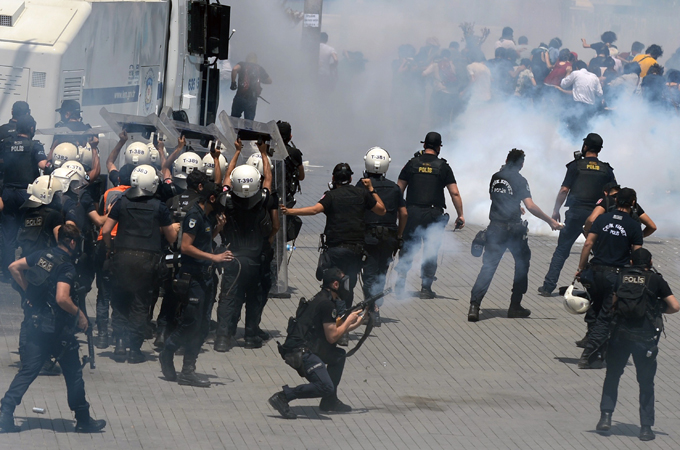
Police in Istanbul have fired tear gas and water cannons at protesters trying to reach a symbolic landmark during a second day of anti-government demonstrations.

Protesters chanted "unite against fascism" and "government resign" on Saturday as they tried to reach Taksim Square, which has long been a venue for political unrest.

Al Jazeera's Gokhan Yivciger reported that there were fierce clashes at police barricades in Harbiye district, about 2km from the square, with riot squads firing salvos of tear gas. An estimated 10,000 people have gathered in the district.

Police also quelled protests this morning in Besiktas neighbourhood, which is on the shores of the Bosphorus nearer to the square.

Saturday's violence came a day after scores of people were injured in clashes in central Istanbul, with 60 people detained around Taksim. Broken glass and rocks were strewn across a main shopping street near the square.

The protest at Taksim's Gezi Park began late on Monday after trees were torn up over a government redevelopment plan. It has now widened into a broader demonstration against what protesters see as increasingly authoritarian rule.

"The protesters are saying that this is not about trees anymore," said Al Jazeera's Rawya Rageh, reporting from Istanbul.

Ibrahin Kalin, the chief adviser to the prime minister, said police had been ordered to withdraw from the area. He told Al Jazeera that tear gas had been fired in response to a group of protesters attacking police as they were leaving the premises.

Prime Minister Recep Tayyip Erdogan acknowledged on Saturday that it was a mistake to use tear gas on the public protesting earlier this week on the planned demolition of Gezi Park.

"There was a mistake while using pepper gas by police forces. Okay. I have ordered the Interior Ministry to investigate this. It was excessive" he said. He, however, said the redevelopment plan for the park would go ahead.

Growing disquiet

Kemal Kilicdaroglu, the leader of the main opposition Republican People's Party, called on Erdogan to withdraw police from the Gezi Park area, and criticised Istanbul governor Huseyin Avni Mutlu over his handling of the situation.

"From now on, in reality, there is no governor in Istanbul", Kilicdaroglu said in a statement.
The unrest reflects growing disquiet at Erdogan's administration and his Islamist-rooted Justice and Development Party.

There have been protests against the government's stance on the conflict in neighbouring Syria, a tightening of restrictions on alcohol sales and warnings against public displays of affection.
However, Erdogan has overseen a transformation in Turkey during his decade in power, turning its economy from crisis-prone into Europe's fastest-growing.

Per capita income has tripled in nominal terms since his party rose to power.

He also remains by far Turkey's most popular politician, and is widely viewed as its most powerful leader since Mustafa Kemal Ataturk founded the modern secular republic on the ashes of the Ottoman Empire 90 years ago.

Julian Assange: a year in the embassy


Wikileaks founder Julian Assange addresses members of the media and supporters from the window of the Ecuadorian embassy in Knightsbridge, west London on December 20, 2012. It is an odd sight: WikiLeaks founder Assange is wearing a jacket and tie, but no shoes. Then again, if you have not stepped outside Ecuador's London embassy for a year, shoes are largely pointless.
Wikileaks founder Julian Assange addresses members of the media and supporters from the window of the Ecuadorian embassy in Knightsbridge, west London on December 20, 2012. Assange is wearing a jacket and tie, but no shoes. Then again, if you have not stepped outside Ecuador's London embassy for a year, shoes are largely pointless.

FRANCE 24 latest world news report
16 JUNE 2013 - 11H42

AFP - It is an odd sight: WikiLeaks founder Julian Assange is wearing a jacket and tie, but no shoes. Then again, if you have not stepped outside Ecuador's London embassy for a year, shoes are largely pointless.
In an interview with AFP to mark this strange anniversary, the man behind the whistleblowing website that unleashed the wrath of Washington insisted diplomats have the potential to end the deadlock that has left him trapped.
Like something out of a spy novel, Assange, a 41-year-old former computer hacker from Australia, walked into the embassy on June 19, 2012 and claimed asylum in a sensational bid to avoid extradition to Sweden for questioning over alleged sex crimes.
Ecuador granted his request, accepting his fears that if sent to Sweden he might be passed on to the United States and prosecuted for publishing thousands of classified war logs from Iraq and Afghanistan and a cache of diplomatic cables.
But Britain has refused to grant him safe passage to Ecuador.
For a year, police have maintained a 24-hour guard at the doors of the embassy -- a modest apartment around the corner from the Harrods department store -- and are poised to arrest him if he tries to leave.
The last year, Assange says, has been like living on a space station. He has used a sun lamp to make up for the lack of natural light, and exercises on a treadmill.
He has also been getting on with the business of being a thorn in Washington's side.
"You ask how I deal with the difficulties of being confined. Well actually, my mind is not confined," he said, leaning back in a chair in the embassy's tastefully decorated front room.
"The physical circumstances are difficult. However, I'm working every day."
He spoke as shockwaves reverberated around the world over the biggest US leak since WikiLeaks published the war logs and diplomatic cables in 2010: the exposure of spy agencies' massive electronic surveillance programmes.
Edward Snowden, an ex-CIA employee who says from exile in Hong Kong that his conscience drove him to reveal the scale of the government's spying on the public, faces a criminal probe -- and Assange fears he will be treated as harshly as WikiLeaks' leaker Bradley Manning.
"Mr Snowden is as good an example of a hero as any. He has performed an extremely courageous act," said Assange, hailing him for exposing America's "creeping mass surveillance state".
"What we don't want to see is him ending up the same way as Bradley Manning -- detained without trial, abused in prison and now facing life imprisonment."
Manning, a 25-year-old US soldier, is being court-martialled for passing the war logs and cables to WikiLeaks, with prosecutors arguing that leaking classified information is equivalent to helping Al-Qaeda.
Aiding the enemy can carry the death sentence, though prosecutors are not seeking it in Manning's case.
"They're trying to erect a precedent that speaking to the media is the communicating with the enemy -- a death penalty offence," said Assange.
"What's at stake in this trial is the future of press in the United States and in the rest of the world."
The name of the silver-haired WikiLeaks founder has come up frequently during the court-martial, which began on June 3. He claims there is a sealed US indictment against him, and that his conviction is a "99-percent chance" certainty if he ever ends up on US territory.
Assange's critics accuse him of hiding from justice over the sex allegations -- which he denies -- saying his fears of being passed from Sweden to the US are unfounded.
Entering the embassy was the final twist in a long legal battle over the allegations. But Assange claims Britain and Ecuador can reach a deal that will see him leave "within a year".
"I think the position in the UK is softening. Of course, it will never publicly humiliate the United States by offering me safe passage in a manner that doesn't seem to be forced," he said.
"But there's lots of ways of saving the pride of Sweden, Australia, the UK and the United States," he added, without specifying them.
He insists Britain is breaking international law by refusing to let him travel to Ecuador as a refugee -- but admitted it was difficult to imagine a scenario in which he could leave without being handcuffed.
Will there eventually come a day when he just gives up and walks outside?
"When I've had enough? I don't know. It's hard to say. At the moment we're doing such good work," he said.
Although its recent scoops have been much lower-profile than the cables and war logs, it continues to publish leaks from around the world, including millions of Syrian politicians' emails and US files on Guantanamo Bay.
Where will he be this time next year? "Hopefully Australia, Ecuador, travelling the world," he said.

Syria: Putin backs Assad and berates west over proposal to arm rebels

Russian president says backing 'those who kill their enemies and eat their organs' flouts Europe's humanitarian values
in Enniskillen | The Guardian,

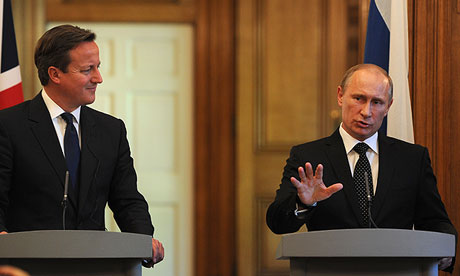
David Cameron and Russia's President Vladimir Putin after talks on the Syrian crisis at No 10
David Cameron, left, with Russia's President Vladimir Putin after they held talks in Downing Street on differences over the Syrian crisis. Photograph: Anthony Devlin/PA


A diplomatic breakthrough on the Syrian civil war at the G8 summit in Northern Ireland appeared unlikely when the Russian president, Vladimir Putin, chastised the west for considering arming Syrian rebels, saying they ate human organs. He said Russia by contrast was arming the legitimate government of Syria.

Speaking after a difficult meeting with Putin in Downing Street, David Cameron claimed both men were in agreement on the need to end the human catastrophe of the civil war. But there was little to suggest the two men made progress on how to convene a fresh Syrian peace conference in Geneva, let alone who should attend, or its agenda.

In icy exchanges at a press conference, Putin said: "You will not deny that one does not really need to support the people who not only kill their enemies, but open up their bodies, eat their intestines in front of the public and cameras. Are these the people you want to support? Is it them who you want to supply with weapons? Then this probably has little relation to humanitarian values that have been preached in Europe for hundreds of years."

Putin's remarks will find an echo on the Conservative benches, where there is strong resistance to arming the Syrian opposition. Cameron has argued that it is possible to arm the pluralist democratic elements of the opposition, and he too wants to drive al-Qaida from Syria.

The talks Putin followed a decision by President Barack Obama's administration to arm rebels trying to overthrow President Bashar al-Assad after the US said it had obtained proof that the Syrian government had used chemical weapons. Some of the proof was provided by British scientists at Porton Down, and Cameron has now accused Assad of committing war crimes.

Cameron admitted the Russians and the UK held different points of view, but said the two countries would put aside their differences and focus on the "common ground" – organising peace talks between the parties in Geneva. Putin said he fully shared Cameron's view that the civil war could be ended "only by political and diplomatic means".

Cameron added: "We both see the humanitarian catastrophe. We both see the dangers of instability and extremism. We both want to see a peace process and a transition. The challenge for the G8 … is to put aside some of these differences."
The Russian leader, who arrived an hour late for the talks, said he wanted to help broker a peace deal for Syria, and he hoped the G8 summit in Northern Ireland could advance that process. Putin insisted his government was "not breaching any rules" in supplying weapons to Bashar al-Assad's "legitimate government" and called on partner G8 countries to respect the same rules.

"What I take from our conversation today is that we can overcome these differences if we recognise that we share some fundamental aims: to end the conflict, to stop Syria breaking apart, to let the Syrian people decide who governs them, and to take the fight to the extremists and defeat them," said Cameron.

In a sign of deteriorating relations among the G8, the Canadian prime minister, Steve Harper, claimed Putin was backing Assad's "thugs".

"I don't think we should fool ourselves," he said. "This is G7 plus one. We in the west have a very different perspective on this situation. Mr Putin and his government are supporting the thugs of the Assad regime for their own reasons that I do not think are justifiable, and Mr Putin knows my view on that."

Cameron's argument that it was possible to keep arms supplies out of the hands of extremist elements of the rebels was flatly contradicted by the mayor of London, Boris Johnson, who warned that there would be no way to prevent weapons ending up in the hands of "al-Qaida-affliated thugs".

Writing in the Daily Telegraph, Johnson said some elements of the rebels were fighting "not for freedom but for a terrifying Islamic state in which they would have the whip hand – and yet there is no dodging or fudging the matter: these are among the Syrian rebels who are hoping now to benefit from the flow of Western arms".

Cameron was also under pressure from his coalition partners the Liberal Democrats to avoid dragging Britain into a military conflict. Nick Clegg, the Lib Dem leader, implied that the case for intervention was less clear cut than in Libya or Iraq.

The shadow foreign secretary, Douglas Alexander, said MPs of all parties were feeling unease. "For months Labour has called on the government to answer basic questions about their approach, such as how the prime minister would ensure that weapons supplied did not fall into the wrong hands, and how this step would help to de-escalate the conflict rather than prolong it.

"The G8 is a key window of opportunity for David Cameron to exert pressure on President Putin and it is vital that he uses the coming hours to do so."

Tory MP Julian Lewis said it would be "suicidal" for Britain to hand arms to an opposition the government admits includes extremist elements.

He told the BBC's Radio 4: "The reason it would be suicidal would be that in taking over Syria they would also inherit Syria's arsenal of weapons, including in particular the nerve gas which is the centre of so much attention.

"In the past we have gone to war because we feared that weapons of mass destruction might fall into the hands of al-Qaida and it would be absolutely crazy to assist al-Qaida to get their hands on the very sorts of weapons we must keep away from them at all costs.

"I have little doubt the prime minister would struggle to get this achieved by parliament, because so many think it is not in Britain's national interest."

Mientras trabajaba para los espías, Snowden era muy prolífico en internet

Reuters – vie, 14 jun 2013
Por John Shiffman y Mark Hosenball y Kristina Cooke
WASHINGTON (Reuters) - Mientras trabajaba para agencias de inteligencia estadounidenses, Edward Snowden tenía otra identidad secreta: comentador online que de forma anónima protestaba contra la vigilancia de la ciudadanía y la avaricia corporativa.
A lo largo de los ocho años que Snowden trabajó para contratistas de la Agencia Central de Inteligencia (CIA) y la Agencia de Seguridad Nacional (NSA), publicó cientos de mensajes en un foro público en internet bajo seudónimo.
"No puedo esperar cambiar la forma en que van las cosas quejándome abiertamente, escribiendo cartas o volando cosas", escribió Snowden en el 2003 en respuesta a una discusión sobre la ambición empresarial en el foro online Ars Technica.
"Esa no es la forma en la que una buena persona hace las cosas. Sin embargo, haré lo que pueda con las herramientas que tengo disponibles", agregó.
La nueva información descubierta por Reuters sobre el historial laboral de Snowden, comentarios en línea y su educación se conocen en momentos en que congresistas estadounidenses interrogan a los responsables de seguridad para averiguar cómo un estudiante de 29 años que abandonó la secundaria consiguió acceso a secretos de alto nivel.
Según fuentes consultadas sobre el asunto, Snowden fue empleado por un agencia clasificada sin identificar en Washington desde el 2005 a mediados del 2006, por la CIA desde el 2006 al 2009, cuando trabajó en el extranjero, y por Dell Inc desde el 2009 al 2013, trabajando en Estados Unidos y Japón subcontratado por la NSA.
También fue un comentarista prolífico en el foro de tecnología Ars Technica, publicando aproximadamente 750 mensajes con el apodo "The True HOOHA" desde finales del 2001 hasta el 2012.
Muchos de los mensajes no eran políticos: ofrecía consejos sobre carreras gubernamentales, polígrafos y la caída del mercado del 2008. Dijo que poseía la misma pistola que James Bond y publicaba fotos suyas glamurosas. En tono de broma, comparaba la videoconsola Xbox Live con la vigilancia de la NSA.
En los mensajes, sin embargo, hablaba del tema ahora conocido de la connivencia empresarial con los programas de escuchas del Gobierno. El 4 de febrero del 2010, mientras trabajaba para Dell, comentó una discusión sobre una empresa tecnológica importante que supuestamente estaba dando acceso a sus servidores al Gobierno estadounidense.
"De verdad me preocupa lo poco que este tipo de comportamiento corporativo molesta a los que están fuera de los círculos tecnológicos", escribió Snowden. "La sociedad realmente parece haber desarrollado una obediencia incuestionable hacia los tipos siniestros".
No está claro si sus jefes conocían su identidad en línea. La CIA, la NSA, Dell y Booz Allen Hamilton, que recientemente emplearon a Snowden, declinaron hacer comentarios.
Un ex funcionario de seguridad nacional dijo que el Gobierno debería haber investigado más. Pero Stewart Baker, ex consejero general de la NSA, dijo que tener esos puntos de vista no descalifica a alguien automáticamente para un trabajo sensible del Gobierno.
"Quizás el Gobierno tendrá que volver a revisarlo, pero es algo difícil de decidir", dijo Baker.
BAJO ESCRUTINIO
Según las fuentes, Snowden dijo a sus jefes que recibió clases de informática en la Universidad Johns Hopkins de Baltimore, que obtuvo un título en el campus de la Universidad de Maryland en Tokio y que en el 2013 esperaba conseguir un master en seguridad informática de la Universidad de Liverpool, en Inglaterra.
Una portavoz de Johns Hopkins dijo que no pudo encontrar un registro de la asistencia de Snowden, pero que podría haber hecho cursos por correspondencia, cuyos datos no se guardan. Un funcionario de Maryland confirmó que Snowden acudió al menos a un curso de verano. Una portavoz de Liverpool señaló que se registró para hacer un master online en seguridad informática en 2011, pero que no lo terminó.
Nacido en 1983 en Carolina del Norte, Snowden creció en un barrio de Maryland cerca de la sede de la NSA. Dejó el instituto en décimo grado y después terminó la secundaria. A los 18 años, trabajó como webmaster para Ryuhana Press, una empresa que promueve a artistas japoneses de anime.
Snowden comenzó a publicar en Ars Technica el 29 de diciembre del 2001. Buscaba ayuda técnica para su trabajo en la página de anime y una empresa web llamada Clockwork Chihuahua.
En Ars Technica, Snowden ofreció más consejos de los que buscaba. Para aquellos que trataban de conseguir puestos en el Gobierno, se quejaba del elevado costo de la vida y de lo molesto del transporte en Washington.
(Información de John Shiffman y Mark Hosenball en Washington, y Kristina Cooke en San Francisco. Traducido por la Redacción de Madrid; editado por Carlos Aliaga vía Mesa Santiago)

jueves, 13 de junio de 2013

Edward Snowden: the whistleblower behind the NSA surveillance revelations


The 29-year-old source behind the biggest intelligence leak in the NSA's history explains his motives, his uncertain future and why he never intended on hiding in the shadows
The individual responsible for one of the most significant leaks in US political history is Edward Snowden, a 29-year-old former technical assistant for the CIA and current employee of the defence contractor Booz Allen Hamilton. Snowden has been working at the National Security Agency for the last four years as an employee of various outside contractors, including Booz Allen and Dell.
The Guardian, after several days of interviews, is revealing his identity at his request. From the moment he decided to disclose numerous top-secret documents to the public, he was determined not to opt for the protection of anonymity. "I have no intention of hiding who I am because I know I have done nothing wrong," he said.
Snowden will go down in history as one of America's most consequential whistleblowers, alongside Daniel Ellsberg and Bradley Manning. He is responsible for handing over material from one of the world's most secretive organisations – the NSA.
In a note accompanying the first set of documents he provided, he wrote: "I understand that I will be made to suffer for my actions," but "I will be satisfied if the federation of secret law, unequal pardon and irresistible executive powers that rule the world that I love are revealed even for an instant."
Despite his determination to be publicly unveiled, he repeatedly insisted that he wants to avoid the media spotlight. "I don't want public attention because I don't want the story to be about me. I want it to be about what the US government is doing."
He does not fear the consequences of going public, he said, only that doing so will distract attention from the issues raised by his disclosures. "I know the media likes to personalise political debates, and I know the government will demonise me."
Despite these fears, he remained hopeful his outing will not divert attention from the substance of his disclosures. "I really want the focus to be on these documents and the debate which I hope this will trigger among citizens around the globe about what kind of world we want to live in." He added: "My sole motive is to inform the public as to that which is done in their name and that which is done against them."
He has had "a very comfortable life" that included a salary of roughly $200,000, a girlfriend with whom he shared a home in Hawaii, a stable career, and a family he loves. "I'm willing to sacrifice all of that because I can't in good conscience allow the US government to destroy privacy, internet freedom and basic liberties for people around the world with this massive surveillance machine they're secretly building."

'I am not afraid, because this is the choice I've made'

Three weeks ago, Snowden made final preparations that resulted in last week's series of blockbuster news stories. At the NSA office in Hawaii where he was working, he copied the last set of documents he intended to disclose.
He then advised his NSA supervisor that he needed to be away from work for "a couple of weeks" in order to receive treatment for epilepsy, a condition he learned he suffers from after a series of seizures last year.
As he packed his bags, he told his girlfriend that he had to be away for a few weeks, though he said he was vague about the reason. "That is not an uncommon occurrence for someone who has spent the last decade working in the intelligence world."
On May 20, he boarded a flight to Hong Kong, where he has remained ever since. He chose the city because "they have a spirited commitment to free speech and the right of political dissent", and because he believed that it was one of the few places in the world that both could and would resist the dictates of the US government.
In the three weeks since he arrived, he has been ensconced in a hotel room. "I've left the room maybe a total of three times during my entire stay," he said. It is a plush hotel and, what with eating meals in his room too, he has run up big bills.
He is deeply worried about being spied on. He lines the door of his hotel room with pillows to prevent eavesdropping. He puts a large red hood over his head and laptop when entering his passwords to prevent any hidden cameras from detecting them.
Though that may sound like paranoia to some, Snowden has good reason for such fears. He worked in the US intelligence world for almost a decade. He knows that the biggest and most secretive surveillance organisation in America, the NSA, along with the most powerful government on the planet, is looking for him.
Since the disclosures began to emerge, he has watched television and monitored the internet, hearing all the threats and vows of prosecution emanating from Washington.
And he knows only too well the sophisticated technology available to them and how easy it will be for them to find him. The NSA police and other law enforcement officers have twice visited his home in Hawaii and already contacted his girlfriend, though he believes that may have been prompted by his absence from work, and not because of suspicions of any connection to the leaks.
"All my options are bad," he said. The US could begin extradition proceedings against him, a potentially problematic, lengthy and unpredictable course for Washington. Or the Chinese government might whisk him away for questioning, viewing him as a useful source of information. Or he might end up being grabbed and bundled into a plane bound for US territory.
"Yes, I could be rendered by the CIA. I could have people come after me. Or any of the third-party partners. They work closely with a number of other nations. Or they could pay off the Triads. Any of their agents or assets," he said.
"We have got a CIA station just up the road – the consulate here in Hong Kong – and I am sure they are going to be busy for the next week. And that is a concern I will live with for the rest of my life, however long that happens to be."
Having watched the Obama administration prosecute whistleblowers at a historically unprecedented rate, he fully expects the US government to attempt to use all its weight to punish him. "I am not afraid," he said calmly, "because this is the choice I've made."
He predicts the government will launch an investigation and "say I have broken the Espionage Act and helped our enemies, but that can be used against anyone who points out how massive and invasive the system has become".
The only time he became emotional during the many hours of interviews was when he pondered the impact his choices would have on his family, many of whom work for the US government. "The only thing I fear is the harmful effects on my family, who I won't be able to help any more. That's what keeps me up at night," he said, his eyes welling up with tears.

'You can't wait around for someone else to act'

Snowden did not always believe the US government posed a threat to his political values. He was brought up originally in Elizabeth City, North Carolina. His family moved later to Maryland, near the NSA headquarters in Fort Meade.
By his own admission, he was not a stellar student. In order to get the credits necessary to obtain a high school diploma, he attended a community college in Maryland, studying computing, but never completed the coursework. (He later obtained his GED.)
In 2003, he enlisted in the US army and began a training program to join the Special Forces. Invoking the same principles that he now cites to justify his leaks, he said: "I wanted to fight in the Iraq war because I felt like I had an obligation as a human being to help free people from oppression".
He recounted how his beliefs about the war's purpose were quickly dispelled. "Most of the people training us seemed pumped up about killing Arabs, not helping anyone," he said. After he broke both his legs in a training accident, he was discharged.
After that, he got his first job in an NSA facility, working as a security guard for one of the agency's covert facilities at the University of Maryland. From there, he went to the CIA, where he worked on IT security. His understanding of the internet and his talent for computer programming enabled him to rise fairly quickly for someone who lacked even a high school diploma.
By 2007, the CIA stationed him with diplomatic cover in Geneva, Switzerland. His responsibility for maintaining computer network security meant he had clearance to access a wide array of classified documents.
That access, along with the almost three years he spent around CIA officers, led him to begin seriously questioning the rightness of what he saw.
He described as formative an incident in which he claimed CIA operatives were attempting to recruit a Swiss banker to obtain secret banking information. Snowden said they achieved this by purposely getting the banker drunk and encouraging him to drive home in his car. When the banker was arrested for drunk driving, the undercover agent seeking to befriend him offered to help, and a bond was formed that led to successful recruitment.
"Much of what I saw in Geneva really disillusioned me about how my government functions and what its impact is in the world," he says. "I realised that I was part of something that was doing far more harm than good."
He said it was during his CIA stint in Geneva that he thought for the first time about exposing government secrets. But, at the time, he chose not to for two reasons.
First, he said: "Most of the secrets the CIA has are about people, not machines and systems, so I didn't feel comfortable with disclosures that I thought could endanger anyone". Secondly, the election of Barack Obama in 2008 gave him hope that there would be real reforms, rendering disclosures unnecessary.
He left the CIA in 2009 in order to take his first job working for a private contractor that assigned him to a functioning NSA facility, stationed on a military base in Japan. It was then, he said, that he "watched as Obama advanced the very policies that I thought would be reined in", and as a result, "I got hardened."
The primary lesson from this experience was that "you can't wait around for someone else to act. I had been looking for leaders, but I realised that leadership is about being the first to act."
Over the next three years, he learned just how all-consuming the NSA's surveillance activities were, claiming "they are intent on making every conversation and every form of behaviour in the world known to them".
He described how he once viewed the internet as "the most important invention in all of human history". As an adolescent, he spent days at a time "speaking to people with all sorts of views that I would never have encountered on my own".
But he believed that the value of the internet, along with basic privacy, is being rapidly destroyed by ubiquitous surveillance. "I don't see myself as a hero," he said, "because what I'm doing is self-interested: I don't want to live in a world where there's no privacy and therefore no room for intellectual exploration and creativity."
Once he reached the conclusion that the NSA's surveillance net would soon be irrevocable, he said it was just a matter of time before he chose to act. "What they're doing" poses "an existential threat to democracy", he said.

A matter of principle

As strong as those beliefs are, there still remains the question: why did he do it? Giving up his freedom and a privileged lifestyle? "There are more important things than money. If I were motivated by money, I could have sold these documents to any number of countries and gotten very rich."
For him, it is a matter of principle. "The government has granted itself power it is not entitled to. There is no public oversight. The result is people like myself have the latitude to go further than they are allowed to," he said.
His allegiance to internet freedom is reflected in the stickers on his laptop: "I support Online Rights: Electronic Frontier Foundation," reads one. Another hails the online organisation offering anonymity, the Tor Project.
Asked by reporters to establish his authenticity to ensure he is not some fantasist, he laid bare, without hesitation, his personal details, from his social security number to his CIA ID and his expired diplomatic passport. There is no shiftiness. Ask him about anything in his personal life and he will answer.
He is quiet, smart, easy-going and self-effacing. A master on computers, he seemed happiest when talking about the technical side of surveillance, at a level of detail comprehensible probably only to fellow communication specialists. But he showed intense passion when talking about the value of privacy and how he felt it was being steadily eroded by the behaviour of the intelligence services.
His manner was calm and relaxed but he has been understandably twitchy since he went into hiding, waiting for the knock on the hotel door. A fire alarm goes off. "That has not happened before," he said, betraying anxiety wondering if was real, a test or a CIA ploy to get him out onto the street.
Strewn about the side of his bed are his suitcase, a plate with the remains of room-service breakfast, and a copy of Angler, the biography of former vice-president Dick Cheney.
Ever since last week's news stories began to appear in the Guardian, Snowden has vigilantly watched TV and read the internet to see the effects of his choices. He seemed satisfied that the debate he longed to provoke was finally taking place.
He lay, propped up against pillows, watching CNN's Wolf Blitzer ask a discussion panel about government intrusion if they had any idea who the leaker was. From 8,000 miles away, the leaker looked on impassively, not even indulging in a wry smile.
Snowden said that he admires both Ellsberg and Manning, but argues that there is one important distinction between himself and the army private, whose trial coincidentally began the week Snowden's leaks began to make news.
"I carefully evaluated every single document I disclosed to ensure that each was legitimately in the public interest," he said. "There are all sorts of documents that would have made a big impact that I didn't turn over, because harming people isn't my goal. Transparency is."
He purposely chose, he said, to give the documents to journalists whose judgment he trusted about what should be public and what should remain concealed.
As for his future, he is vague. He hoped the publicity the leaks have generated will offer him some protection, making it "harder for them to get dirty".
He views his best hope as the possibility of asylum, with Iceland – with its reputation of a champion of internet freedom – at the top of his list. He knows that may prove a wish unfulfilled.
But after the intense political controversy he has already created with just the first week's haul of stories, "I feel satisfied that this was all worth it. I have no regrets."