jueves, 16 de mayo de 2013

Nicaragua nabs US most-wanted child porn suspect


Nicaragua's National Police agents escort U.S. citizen Eric Justin Toth to be presented to the press at a police station in Managua, Nicaragua, Monday April 22, 2013. Toth was detained by police Saturday, April 10, 2013, in Esteli, a city near Nicaragua's border with Honduras. Toth is on the FBI's 10 most-wanted fugitives as a suspect in a child pornography investigation, authorities confirmed Monday. (AP Photo/Esteban Felix)


MANAGUA, Nicaragua (AP) — Police in Nicaragua have detained a former U.S. school teacher who was on the FBI's 10 most-wanted fugitives as a suspect in a child pornography investigation, authorities confirmed Monday.
Eric Justin Toth was detained Saturday in Esteli, a city near Nicaragua's border with Honduras, and will be immediately deported to the United States, said National Police chief Aminta Granera.
"Toth will be deported immediately because he was in our country illegally," Granera said at a news conference in Managua, the capital.
She said Toth entered Nicaragua with a false passport and also had a fake driver's license and credit cards.
Toth was being handed over to FBI agents present at the news conference and they planned to take him to the U.S. in a special plane, Granera said.
A thin and nervous-looking Toth dressed in cream-colored shirt and pants was briefly presented to journalists and photographers who took his picture, but he wasn't allowed to talk and was quickly taken away.
Granera said Toth first entered Nicaragua on Oct. 24, 2012, and left on Jan. 27. He returned on Feb. 12 and that's when Nicaraguan police began keeping a close watch, she said.
"He was captured in a house in the Panama Soberana neighborhood in Esteli, even though he resisted," Granera said.
Toth taught third grade at Beauvoir, a private elementary school on the grounds of the Washington National Cathedral. He was escorted off campus in June 2008 after another teacher reported finding sexually explicit photographs on a school camera in Toth's possession. He had not been seen since he lost his job.
In a statement, the school commended the work of U.S. authorities.
"We commend the work of the Office of the U.S. Attorney and the FBI for their ongoing efforts to apprehend Mr. Toth. They have been tenacious and resolute in their quest to bring this case to justice," it said.
Toth was added to the FBI's most-wanted list in April 2012 for allegedly possessing and producing child pornography, giving him notoriety normally reserved for people sought in connection with violent crimes or terrorism.
Osama bin Laden and purported Boston mobster James "Whitey" Bulger have both been featured on that list, but the FBI said it put Toth on because there were no reliable clues as to his whereabouts and because his Internet skills and alleged penchant for grooming children made him especially dangerous.
Authorities found Toth's car at the Minneapolis-St. Paul International Airport in August 2008 with a note suggesting he'd committed suicide in a nearby lake. But no body was found.
The FBI, which had been offering a $100,000 reward for information leading to Toth's arrest, said he was believed to have traveled to Virginia, Illinois, Indiana, Wisconsin and Minnesota. It said Toth is originally from Hammond, Indiana, and is a graduate of Purdue University.
Toth is thought to have lived in Arizona in 2009.
The bureau had said that Toth might have been advertising as a tutor or a male nanny and using the alias of David Bussone.
___
Associated Press writer Eric Tucker in Washington contributed to this report.

América Latina sigue siendo la región más desigual del mundo, pese a las mejoras

AFP – jue, 25 abr 2013

América Latina sigue siendo la región del mundo con mayor desigualdad en el ingreso, pese a que ha logrado mejoras en ese campo en la última década, aseguró este miércoles en Panamá una fuente del Programa de las Naciones Unidas para el Desarrollo (PNUD). (AFP | Eitan Abramovich)
 AFP - América Latina sigue siendo la región del mundo con mayor desigualdad en el ingreso, pese a que ha logrado mejoras en ese campo en la última década, aseguró este miércoles en Panamá una fuente del Programa de las Naciones Unidas para el Desarrollo (PNUD). (AFP | Eitan Abramovich)
 Esa circunstancia se da a pesar de que en América Latina, "por primera vez en cuatro décadas", durante los dos últimos años la desigualdad en la distribución del ingreso "ha disminuido", algo que no ha ocurrido en ninguna otra parte del mundo, según Gómez. (AFP | Miguel Álvarez)

América Latina sigue siendo la región del mundo con mayor desigualdad en el ingreso, pese a que ha logrado mejoras en ese campo en la última década, aseguró el miércoles en Panamá una fuente del Programa de las Naciones Unidas para el Desarrollo (PNUD).
"América Latina sigue siendo la región del mundo que tiene más alta desigualdad, de lejos", manifestó en conferencia de prensa Hernando Gómez, Coordinador del Informe Nacional de Desarrollo Humano de Colombia 2013.
Esa circunstancia se da a pesar de que en América Latina, "por primera vez en cuatro décadas", durante los dos últimos años la desigualdad en la distribución del ingreso "ha disminuido", algo que no ha ocurrido en ninguna otra parte del mundo, según Gómez.
Según este asesor del PNUD, que presentó en Panamá el Informe Mundial de Desarrollo, la desigualdad en Latinoamérica se debe a que en esta región hay más multimillonarios que en otras zonas del mundo. Sin embargo, en la región en su conjunto "ha disminuido" la desigualdad "y eso hay que celebrarlo y valorarlo", expresó Gómez.
El descenso de la desigualdad se debe principalmente al aumento del nivel de educación, la mejora en el sistema de salud y un mayor acceso al empleo y a los programas estatales de transferencias condicionadas.
Según datos del PNUD, Honduras, Bolivia, Colombia, Brasil y Chile serían los países más desiguales por ingreso. Al contrario, Nicaragua es donde se da mayor igualdad de ingresos, seguida de Argentina, Venezuela, Uruguay, Jamaica y Perú.
Gómez aconsejó aunar esfuerzos para una distribución más adecuada del ingreso, que permite crecer económicamente al haber más personas con capacidad de comprar, lo que trasunta en mayor producción. Además, la desigualdad "se traduce en muchos males, desde la úlcera, el estrés, los conflictos sociales, la criminalidad o la inestabilidad política", aseguró Gómez.
América Latina sigue siendo la región del mundo con mayor desigualdad en el ingreso, pese a que ha logrado mejoras en ese campo en la última década, aseguró este miércoles en Panamá una fuente del Programa de las Naciones Unidas para el Desarrollo (PNUD).
Esa circunstancia se da a pesar de que en América Latina, "por primera vez en cuatro décadas", durante los dos últimos años la desigualdad en la distribución del ingreso "ha disminuido", algo que no ha ocurrido en ninguna otra parte del mundo, según Gómez.


La playa de los pobres en Perú
Mientras la elite se aleja de Lima en busca de playas casi solitarias que resguardan con guardias privados y cercas, la clase obrera arriba por millares a una curva franja costera de arenas pardas y suave oleaje. Se llama Agua Dulce y los bañistas sólo necesitan dos dólares en el autobús público para ir y volver a sus barriadas. "Aquí viene la gente del pueblo por millares y hay domingos en los que no cabe ni un alfiler", dice Carlos Vergara, un fotógrafo ambulante que ha recorrido las playas de Lima durante 50 años. Hasta mediados del siglo XX el verano era una estación donde sólo las clases adineradas podían darse el lujo de viajar hasta las playas. Los pobres se bañaban en ríos o canales de riego de la ciudad, agrega el historiador especialista en Lima Juan Pacheco. Pero la construcción de vías hacia zonas costeras junto a la migración de millones de jóvenes campesinos hambrientos de progreso desde los Andes redibujaron la población capitalina que se lanzó a la conquista de las playas más cercanas a la ciudad. Así se masificó Agua Dulce, que un fin de semana alberga hasta 40.000 personas, según cifras municipales. Al caer la tarde el cielo se torna anaranjado y las madres llevan a sus hijos a una zona donde brota un chorro de agua dulce, por el cual la playa adquiere ese nombre. Allí los bañan antes de retornar a casa. Sin vida nocturna Agua Dulce queda desierta cuando oscurece mientras los camiones municipales recogen las más de 10 toneladas de basura esparcidas por la franja de casi un kilómetro. (AP)


Inundaciones del 2 de Abril

El comedor de Vivi


Bolsas de donaciones
Soleada y templada mañana de Domingo en La Plata. Pasaron 5 días desde la noche de las inundaciones, por la calle 13 todavía se ven vestigios de lo que pasó, grandes charcos de agua, más basura que lo normal, en los alambrados de las casas bastante espaciadas se ven algunas cosas secándose. Pero no solo la inundación pasó por aca, las marcas de goma quemada en el asfalto nos muestran que también pasó la bronca.
por Gonzalo de Pedro
El hospital móvil de la provincia de Buenos Aires está a un lado de la ruta, dos grandes escaleras le sirven de entradas. En la primera una familia sentada, quizás esperando que los atiendan, en la otra una médica asomada. Estos días atendieron muchas personas, no sabrían decir cuantas, de problemas respiratorios y algunos chicos con diarrea. Frente al hospital, separado por una zanja de la banquina y alrededor de medio metro bajo el nivel de la calle se levanta una casita. De material y madera, frágil y humilde. En el frente se improvisó un centro de reparto de donaciones. Dos mesas de 3 metros por medio metro repletas de ropa es escrutada por alrededor de 15 personas, buscan la ropa que necesitan. Del otro lado sobre un auto viejo se armo un improvisado exhibidor de zapatos. Entre la casa y todo esto dos mesas más. Una con productos de limpieza, que dos señoras fraccionan y entregan al que necesite. En la otra se reciben pedidos de ropa más especificos, pañales, lo que sea. La actividad es frenética, todos van y vienen. Una camioneta Ford con un remolque es cargada de ropa y mercadería por 3 hombres. Hay dos autos atrás de ella que también son cargados. Intentando coordinar todo esta Vivi, quien junto con su familia dirige este espacio que ahora es centro de asistencia, pero antes fue comedor y lugar de encuentro para las personas del barrio.
Acercarse a hablar con ella es un desafio, cada dos segundos alquién se le acerca a pedirle o a preguntarle algo. Ella piensa, ordena, reparte donaciones, da consejos y dice donde buscar. Así y todo logro hablarle. “Hola Vivi, soy estudiante de periodismo”, lo que debería ser una invitación al diálogo, a contar su versión de la realidad para que sea difundida es respondido con un cortante: “Mirá que aca estamos sin banderas políticas he”. Desconcertado hago un breve discurso sobre mi falta de banderas política, o al menos partidarias porque no creo en mitológicos seres apolíticos, de mi independencia, todo reforzado con el sólido argumento de mi presencia en cuerpo y alma ahí. Vivi baja la guardía, no sin antes preguntarme de que facultad era. Ahí entendí todo, la Facultad de Periodismo de la Universidad Nacional de La Plata es usado como centro de operaciones de la ayuda “oficial”, las donaciones son clasificadas y distribuidas por persona con pecheras de “La Cámpora”.  Digo de que escuela de Periodismo soy, y aclaro, que no soy de La Plata. Es ahí que hay una sonrisa y una especie de disculpa en forma de relato. ” Disculpame, -dice Vivi- lo que pasa es que vinieron unos muchachos diciendo que eran estudiantes de Periodismo también, hablaron conmigo y después se sacaron los chalequitos que tenían y abajo tenían remeras de La Campora, se sacaron fotos y se fueron”.  Sumado a eso Vivi hace un relato de otras malas jugadas que le hicieron. Por ejemplo, dice que le dijeron a la gente que habían bajado 60 colchones en su comedor, cuando ella solo tenía 6 y de donaciones. La gente se enojo y empezó a hacer lio, mientras ella explicaba lo que había pasado le desaparecieron 3 cajas llenas de mercadería. Cada tanto ser acerca alguién y Vivi les dice “periodista”, avisandoles de mi presencia. También cuenta que cuando se pusieron a limpiar la calle vino gente de la cooperativa y les dijeron que ese era trabajo de ellos. Vivi está enojada. Los dichos de ella se repiten con algunas variaciones en varios relatos de las personas de los barrios, lamentablemente son difíciles de comprobar y solo puedo contar lo que ella dice. “Escrachalos a esos hijos de puta”, me pide.
El comedor de Vivi se encuentra en el Barrio Aeropuerto, un barrio ubicado en la zona sur-oeste de La Plata, es humilde, muy humilde. “Hay personas que perdieron todo”, dice y cuenta como no recibió ayuda oficial, solo de voluntarios que vienen y le dejan cosas. Parte de esas donaciones las envian a otros lugares, han ayudado a la gente de 609 y 19, de 604 y 116 y del barrio Palihüe.  ”Los préstamos no sirven, hay gente que no tiene trabajo estable”, nos cuenta un empleado municipal mientras carga un auto y nos dice que el la tiene relativamente fácil, que por lo menos no tiene familia, pero hay gente con chicos que no tienen nada.
“Nos vemos Vivi”, la saludo y me contesta con un “Chau, gracias”.
No Vivi, no. Gracias a vos.

Boston Bombing Suspect Shootout Pictures

Posted by Andrew Kitzenberg on April 22, 2013 750 Comments
 Each of these pictures on this page together with the description of them are individually licensed by Andrew Kitzenberg with the requirement of attribution to Andrew Ktizenberg and a reference to his company’s website www.getonhand.com under a Creative Commons Attribution-NoDerivs 3.0 Unported License
These pictures have been made available to the public for free and I have asked that all news and media outlets please donate a contribution to The ONE FUND Boston.  Please let us know about your donation by emailing media@getonhand.com

UPDATE 2:55PM 4/26/2013: All net proceeds from the sale our BOSTON STRONG USB Wristbands will be donated to the One Fund Boston.  We have already collected over $10,000 to support the victims of the Boston Marathon Attacks.
UPDATE 11:00AM 4/24/2013: The pictures are back up and available to the public.  
UPDATE 3:20PM 4/23/2013: I have decided to take down the photos during the ongoing investigation.

On Thursday night [Friday morning] at 12:45am EST.  I was in my living room working on my computer when I heard multiple “pops” coming from outside.  At that point, I had no idea that I was about to become an eye witness to the biggest news story in the country.

When I looked outside my window, I could clearly see two people (the Tsarnaev brothers) taking cover behind an SUV and engaging in gunfire. After witnessing shots being fired I promptly ran up the stairs to my 3rd floor bedroom to distance myself a little further away from the gunfire. As I ran into my room, overwhelmed by shock, adrenaline, and curiosity, I jumped onto my bed to stay below the windows but also have a clear view at the shooters and photograph the event. As soon as I was laying safely on my bed I started taking pictures with my iPhone 5 and captured the following images that documented the terrifying shootout with the Tsarnaev brothers, which then led to an overnight citywide manhunt.

 
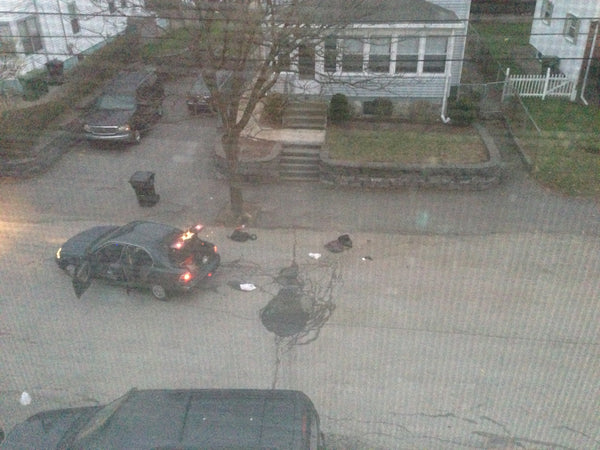
 Here are the two brothers taking cover behind the black Mercedes SUV and shooting towards Watertown Police officers. (Taken at 12:46:11AM)

 
 The shooters were also driving the green sedan on the left. They had the back passenger door open and were going back into the car where they had additional supplies (assumingly, more ammunition and explosives). They also had backpacks at their feet where they also had additional supplies.

 
 This is a view from the west-facing window in my bedroom and at the end of the block (Laurel St.) you can see multiple police vehicles. These vehicles were about 75-80 yards from the shooters. (Taken at 12:46:25AM)

 
 Here it’s clear to see the brothers taking aim and firing on the officers. (Taken at 12:47:57AM)

 
 This is a zoomed in view from the last image. The red circle highlights the pressure cooker bomb that was used just moments after this photo was taken. The use of this explosive created an enormous cloud of smoke that covered the entire street. While the street was still cloudy with smoke one of the brothers started running down the street towards the officers, while still engaging them in gunshots. As he got closer to the officers, within 10 -15 yards of them he was taken down. From my vantage point I did not see whether he was tackled to the ground or brought down by gunshots.

 
As the one brother was running toward the officers the second got back into the SUV, turned it around in the street and proceeded to accelerate at the vehicle barricade. This image shows the black SUV charging the officer vehicles. (Taken 12:50:57AM)

 
This is a zoom-in from the last image and the red circle highlights where one of the brothers was taken down and still laying in the street. The black SUV proceeded to accelerate towards the officers and drove in between the two cars at the top of the picture. The SUV side swiped both cars taking out doors and windows and ultimately broke through the vehicle barricade and continued driving west on Laurel St. This was the last I saw of the black SUV.

 
This image was taken from the east-facing window. As soon as the black SUV had left the street officers rushed toward the green sedan and the spot of the shooting. As soon as officers got to the vehicle they started alerting all others on scene that there were “IEDs” on the street and for everyone examining the scene to clear the entire street. Also pictured at the bottom of the image is a Watertown Police SUV that had crashed in our driveway at the start of the gunfight and had many of its windows shot out. (Taken 12:57:52AM)

 
At the bottom of this image is the blast mark from the pressure cooker bomb that exploded in the middle of the street. At the top of the image, the bright light is a bomb detecting robot that was moving toward the blast mark. (Taken at 1:20:10AM)

 
Here bomb squad personnel inspect the blast mark of the large explosion.  (Taken 1:39:22AM)

 
Here heavily armed agents are still in search of the suspect on Laurel St. (Taken 2:14:54AM)

 
Here is the bomb detecting robot inspecting the vehicle from the back right passenger seat. (Taken at 2:49:19AM)

 
After shooting had stopped my roommate found a bullet hole that penetrated his west-facing wall and continued to pierce through his desk chair. His room is on the 2nd floor corner of the house, closest to the street, with west and south facing walls

 
The bomb squad had finally inspected the entire vehicle and all the backpacks beside it and have cleared the area.  (Taken 5:45:25AM)

 
Armed Agents searching and evacuating all homes on Laurel St. They evacuated ours shortly after this photo was taken. (Taken at 6:01:17AM)

After being evacuated from our home, we spent a long and emotionally straining day in our neighbor’s house down the block. My roommates and I are all very grateful that we made it through such a terrifying event unharmed. These kind of horrifying events make you realize how precious life really is and the need to cherish every moment you have. You quickly reflect on the people that surround you and how important those relationships are in your life. I know I am truly blessed to have my health and safety after this horrible event and am thankful for every person that has touched my life. Thank you to all of my family, friends, and the incredible number of people who reached out with love and support.
Truly Blessed,
Kitz

P.S. Thanks to Acceleration Partners & Growth Spark for all their help and advice.

viernes, 12 de abril de 2013


THE CURSE OF BIN LADEN: DEAD 22 OF 25 MARINES WHO KILLED HIM


Ben 22 25 of the Marines who killed Osama Bin Laden in a raid in Pakistan are mysterious deaths. Just coincidence? Impossible not to connect this with the mysteries that still surround the figure of the "Sheikh of terror."    
April 1st.

When the '11 September 2001 two airliners crashed into the Twin Towers and forever changed the course of history, the wasted complottismi about the attack and the figure of their creator, that' Osama Bin Laden leader of Al Qaeda in many remembered being a faithful friend of the Bush family. At a distance of 12 years in the name of the war on terror the U.S. and NATO invaded Afghanistan and Iraq, and without interference in the Arab world, increasing Western presence in these countries, see Pakistan where drone war tens of sowing deaths each year.

In May 2011 but Osama Bin Laden, at least that we were told, was killed during a raid near Islamabad, Pakistan, by a group of Navy Seal consists 25 unit. The soldiers entered the bunker man most feared and sought after in the world and killed him, though no one has ever been able to see even a proof of his death. In a mysterious way Obama did not want circulated images of the corpse of Bin Laden, the man against whom unleashed the largest global war on terror last century. After almost two years, the 25 marines responsible for the blitz, there are only two left alive. . Following the accident helicopter that killed 22, in August of the same year, in fact, another marine was killed during a training exercise. 

It was Brett D.Shadle, 31enne who was practicing in rolls at low altitude and crashed with his parachute in the Arizona desert. As if that was not enough Matt Bissonnette, one of the marines left alive who took part in the raid, has written a book "No Easy Day", published under the pseudonym of Mark Owen then this book has become the basis of the filmZero dark thirty.Bissonette was threatened with death, and did not request permission to distribute news to his superiors, wasdishonorably discharged.What lies behind the actual death of Bin Laden? And above all, the deaths of 22 marines are just a mere coincidence?